
EPISODE TWO: Following the Money that Brought Hyperscale Data Centers to Kansas
Second in a Five Part Investigative Series that Uncovers Everything You Need to Know...THE TRUTH behind Senate Bill 98 and Hyperscale Data Centers in KansasSubmit your Concerns to your Kansas State Legislators
Support Stand 4 the Land Kansas’ efforts to help Kansans fight Hyperscale Data Center Abuse, let your Kansas Legislators know your thoughts and opinions.
* Denotes required field.
Episode Two: Following the Money
In episode one, we told you a story about a bill, about how a piece of paper became a law, without most of the people it will affect ever hearing its name. We told you what the law does. We told you who signed it. We told you when. In this episode, we’re going to tell you a different story.
Same bill, same law. But this time we’re going to, follow the money, and we’re going to follow the record, and we’re going to name names.
Here is what episode one established on April 24th, 2025, Governor Laura Kelly signed Senate Bill 98 into law. The bill gives certain data center developers a 20 year exemption from Kansas State sales tax, 20 years for any facility that meets the minimum investment threshold.
The law also prohibits public utilities from offering discount electric rates to data center customers, requires water conservation practices, and gives the Kansas Fusion Center the authority to review each project before it’s approved. That’s the text of the bill. That’s the law. Nothing we’re going to tell you changes any of that. What we didn’t tell you in episode one, what we’re going to tell you now, is how that bill became a law, because Senate Bill 98 was not originally about data centers.
Senate Bill 98 was originally Senate Bill 51. Senate Bill 51 was introduced on January 21st, 2025 by the Senate Committee on Commerce. It was written to give data centers a 20 year sales tax exemption if they meet a $250 million minimum investment. It was introduced at the request of an organization called NetChoice.
NetChoice is a trade association based in Washington. Its members include some of the largest technology companies in the world. Check it out, you can view these tech giants on NetChoice’s public membership page.
On January 30th, the Senate Committee on Commerce held a hearing on Senate Bill 51.
The people who testified in favor of the bill are listed in the committee minutes. Their names are as follows and you can click on each to view their testimony in support of the original SB51 to incentivize Hyperscale Data Centers in Kansas:
NetChoice, Polsinelli Law Firm, Kansas Power Alliance, Data Center Developer Diode Ventures, Geiger Ready Mix Concrete Company, Kansas Electric Cooperatives, Inc., KC Tech Council, Evergy the state’s largest utility, DeSoto Chamber of Commerce, Wyandotte County Economic Development Council, Go Topeka, the Kansas Economic Devlopement Alliance, and the Kansas Department of Commerce itself.
One organization opposed the bill, it was called Americans for Prosperity Kansas. That was the whole record. That was the whole hearing. The Senate voted on February 19th 34 to 6. The bill passed the Senate at 11:25 p.m. on a motion for emergency final action.
There were six no votes.
Senator Francisco, a Democrat. Senator Peck, a Republican. Senator Shane, a Republican. Senator Thompson, a Republican. Senator Titus, a Republican. Senator Tyson, a Republican.
One Democrat. Five Republicans.
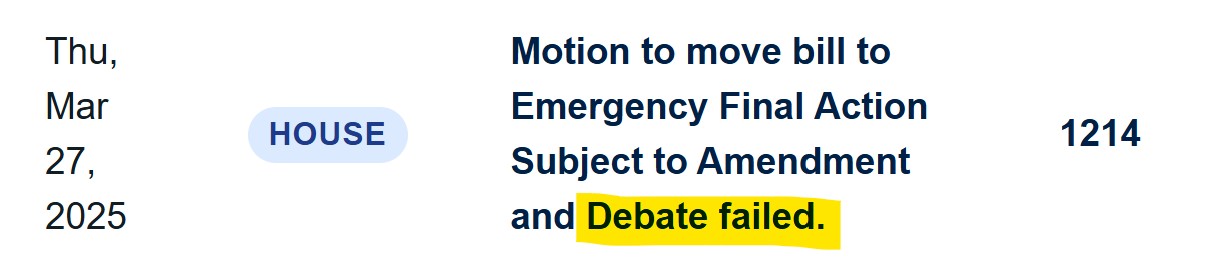
Then the bill went to the House. The House Committee on Taxation held a hearing on March 6th, the same proponents testified. Two organizations opposed, the Sierra Club and again Americans for Prosperity Kansas. The bill sat in the House for three weeks. On March 27th, a motion to move Senate Bill 51 to Emergency Final Action was made on the House floor.
The motion failed. Senate Bill 51 was not going to become law. That should have been the end of it.
Senate Bill 98 was not about data centers. Senate Bill 98 was about a license plate. It was introduced on January 22nd, one day after Senate Bill 51. It was written to authorize a Route 66 commemorative license plate for the Route 66 Association of Kansas.
That’s it. That’s was the whole of Senate bill 98. A specialty license plate bill. Something for the historical society.
The Senate passed it on February 19th, 39 to 1. The one no vote was Senator Tori Marie Blue, a Republican from Great Bend.
The House passed its version on March 13th, 105 to 17. The two chambers disagreed on some small details. Who gets the fee revenue, what the plate design specs are, routine license plate bill details.
So the bill went to a conference committee to hash out the disagreement on a couple small details for the Route 66 license plate. That’s what conference committees are for.
Designated Senators, and House Representatives sit in a room, they work out the differences and bring back a report. The original conference Committee on Senate Bill 98 was named on March 14th
From the Senate:
- Senator Mike Peterson, a Republican from south Wichita, who chairs the Joint Committee on Information Technology
- Senator Rick Kloos, a Republican from Overbrook The Senate majority whip
- Senator Ethan Corson, a Democrat from Fairway The Democratic caucus chair
From the House:
- Representative Shannon Francis, a Republican from Liberal who chairs the House Committee on Transportation
- Representative Robin Essex, a Republican from Olathe, Vice chair of the same committee
- Representative Henry Helgerson, a Democrat from East Borough, the ranking Democrat on transportation.
Six legislators, four Republicans, two Democrats, all with committee jurisdiction over motor vehicles, named to work out the differences on a license plate. That’s not what happened.
By the time the sun came up on the last day of the Kansas legislative session, Senate Bill 51 had been dead for 15 days. The House had refused to bring it up for a final vote on March 27th. That refusal was on the record. That refusal should have been the end of it. It wasn’t.
The instrument they used was already sitting on the calendar. Senate Bill 98, a license plate bill, a Route 66 commemorative plate. Something for the historical Society, something nobody objects to. Two chambers had passed it. Six conferees had been named. It was waiting to be finished.
That’s what was supposed to happen on the morning of April 11th. The Senate went into session, and the presiding officer read a routine appointment into the record. Senator Larry Alley, the Senate Majority leader, was appointed to the SB 98 conference committee. Senator Stephen Owens was appointed to the SB 98 Conference Committee. Senator Mary Ware was appointed to the SB 98 Conference Committee.
They were replacing three sitting members Senator Mike Petersen, Senator Rick Kloos, and Senator Ethan Corson.
Petersen chairs the Joint Committee on Information Technology. That’s the committee with jurisdiction over data centers. He was removed from the conference on the data center bill. Kloos is the Senate majority whip. He was removed from the conference on the data center bill. Corson is the Senate Democratic Caucus chair he was removed from the conference on the data center bill.
Across the rotunda in the House chamber. The same thing happened. Representative Sean Tarwater chair of Commerce, Labor and Economic Development, was appointed to the SB 98 Conference Committee. Representative Stephanie Sawyer Clayton, the ranking Democrat on that committee, was appointed. A third representative was appointed alongside them. They were replacing three sitting conferees, including Representative Henry Helgerson.
Speaker of the House Daniel Hawkins was in the chair when it happened. The whole exchange took less than a minute.
What the new conference committee did in that room was remove the Route 66 language from Senate Bill 98, and insert in its place, the language from Senate Bill 51, the dead bill, the data center bill.
The report says so on its face. It’s in the second paragraph of the conference committee report brief.
“The conference committee agreed to remove the contents of Senate Bill 98 pertaining to a distinctive license plate for the route 66 Association of Kansas. Insert the provisions of Senate Bill 51, as amended by the House, and to further amend the provisions of Senate Bill 51, as follows…”
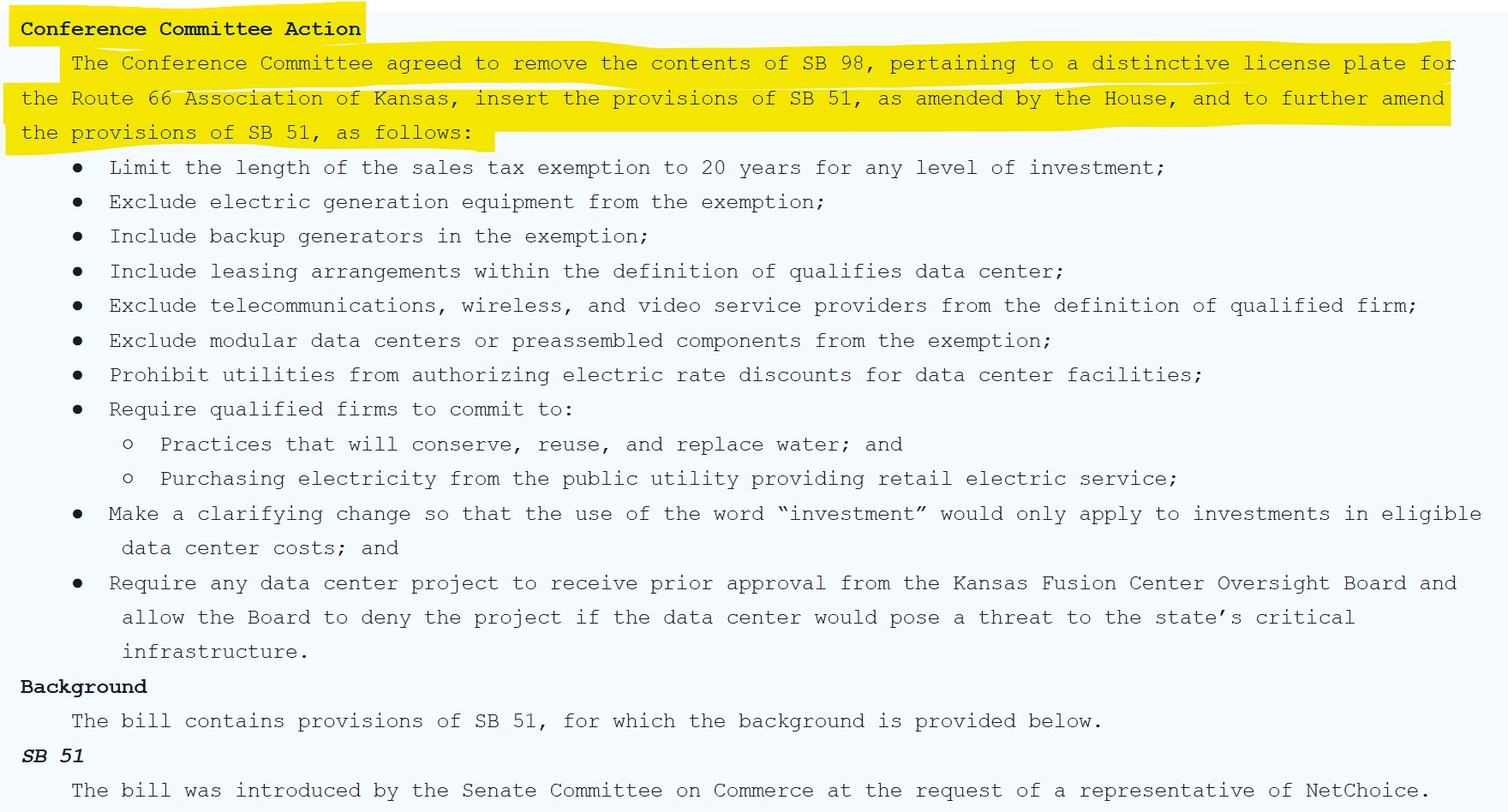
Then they added carve outs. A 20 year tax exemption regardless of investment size. Backup generators included. Modular data centers excluded. Water conservation practices required in language, not an enforcement. no electric rate discounts for data centers. Fusion center review before any approval. Six new provisions negotiated by the four new Republican conferees and the two Democratic replacements, in a room, on the last day of session.
The Senate voted first, to take up the report at all, they had to suspend Kansas Joint Rule 4(k), a rule that requires final conference reports to circulate for a day before a vote. They suspended it. The vote to adopt was 26 to 8. Six senators were absent among the yes votes. Every one of the replacement conferees. Every one of the replaced conferees.
Petersen Voted yes. Kloos Voted yes. Corson voted yes. They had been removed from the negotiation. The final language they voted on was not the language they would have written, but they voted for it.
The House took it up next. The same joint rule for case suspension. The same day.
Representative Leo Delperdang of Wichita carried the report on the floor. He is quoted…
“This bill affects everybody, and we want to make sure we do the right thing.”
That’s on the record. Then Representative Henry Helgerson stood up. Helgerson had been one of the three House members removed from the conference committee that morning. He had lost his seat at the table. He was going to vote against the bill anyway, he is then again quoted…
“Not only will it affect everybody, it’s going to affect the next generation, and the next generation.
I hate to be the spoiler in all of this. There is no requirement of whether they’re going to save any water. People are being told right now not to plant trees, not to put bushes in.
Who’s pushing all this? My guess it’s the investment bankers outside this state. They have billions of dollars they want to bring in.”
The House voted 85 to 37. Three members were absent. Helgerson was in the no column. The rest of the House conference committee, old and new, voted yes. The bill went to Governor Kelley’s desk. She signed it 13 days later.
There is one more thing on the record. One thing we can show you, in a document that you can look up yourself. On October 21st, 2024, six months before any of this happened,
Senator Stephen Owens filed a receipts report with the Kansas Ethics Commission. In his report there is a contribution line item, NetChoice $500 (refer to highlighted section on page 8).

NetChoice is the trade association that requested Senate Bill 51 in January, three months after Senator Stephen Owens filed his receipts report showing the NetChoice contribution, the bill was introduced.
Three months after that, on April 11th, 2025 Senator Stephen Owens was one of the three senators appointed to the SB 98 conference Committee.
Senator Stephen Owens was in the room when the bill was written and when the Senate took up the report, he stood on the floor and defended it. He is quoted…
“It is substantially different with additional guardrails than what passed the Senate. I believe that actually makes this a better bill.”
$500, a contribution receipt from NetChoice to Senator Stephen Owens, on file with the state of Kansas.
Six months later, Senator Stephen Owens has a seat at the table, a vote in favor. He makes a speech in defense of SB 98. That is what we know. That is what the record shows. We are not telling you what to make of it. We are telling you it is there. That’s the record for one bill, one session, one day at the end of the session. The record does not tell us why.
It does not tell us what any of these legislators believed when they cast their votes. It does not tell us what promises were made, or what conversations were had. The record only tells us what happened, who was in the room, who wasn’t, who spoke, who signed, who received what, from whom, when. The rest is up to your own critical thinking.
Here is what else the record shows.
Senator Chase Blasi, a Republican from Andover, voted yes on Senate Bill 51 in February. 11 months later, in this year’s session. Senator Blasi introduced a resolution to place a three year moratorium on new data centers in Kansas counties under drought emergency. The measure failed 12 to 22. It was voted down by the same body that passed Senate Bill 98.
Some of the yes votes on the moratorium were legislators who had voted yes on the failed data center SB 51 tax break bill the year before.
The record shows people can change their minds.
The record shows most did not. Senator Mary Ware, a Democrat from Wichita, one of the three replacement conferees named to Senate Bill 98 on April 11th, resigned from the Kansas Senate on November 13th, 2025.
She cited a need for family time. She was replaced by then Representative Silas Miller.
Senator Ethan Corson, a Democrat from fairway, one of the three senators removed from the conference committee on April 11th, is running for governor of Kansas. He has been endorsed by the current governor. The Democratic primary is in August.
Representative Henry Helgerson, a Democrat from East Burrow, the House member who lost his seat at the table and voted against the bill anyway, filed for reelection. He is facing a contested primary in his own party.
Senator Stephen Owens, who filed the receipt of a $500 NetChoice contribution. Who was the replacement conferee on the SB 98 conference Committee. Who defended the SB 98 on the floor of the Kansas Legislature is up for reelection in 2026. The Primary is on August 4th.
The record shows what happened. The record shows where things are at now. The record does not tell you what to do about it. That’s your ballot. That’s your vote. That’s your choice.
Every fact in this investigation is on the public record. Every quote was made on the floor of the Kansas Legislature, or filed with the Kansas Governmental Ethics Commission, or reported by credible journalists at named and linked publications.
See you in the next episode, three, where we connect the dots and continue to call out the individuals who are a complicit part of the machine.
This is episode two of a five part investigation. We are going to name the players, the lobbyists, the politicians, the out-of-state money. Because Kansas did not lose its water, its land, its power grid and its property tax base by accident. It lost these things in a single afternoon behind a Gut and Go legislative hat trick.